
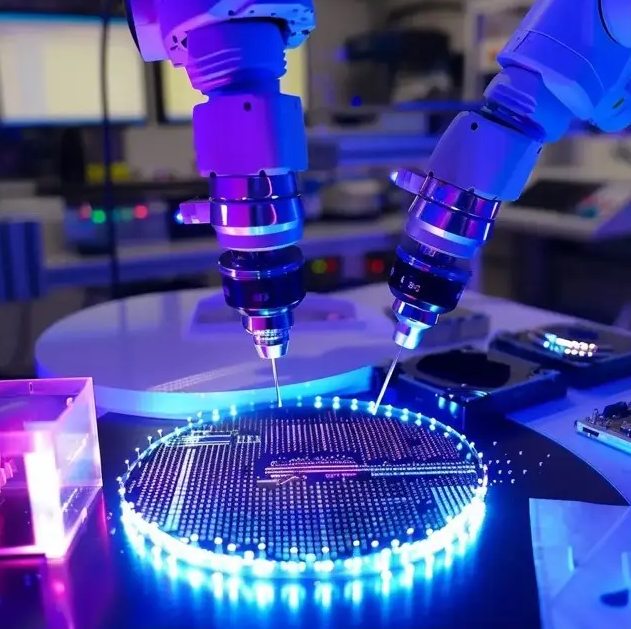
On the line, temperature isn’t a background knob—it drives the process. A couple degrees off during photoresist soft bake can drift your critical dimension (CD) targets. A cold spot during wafer drying can leave a water mark that survives spin, bake, and etch. When the thermal behavior misses, you don’t get a heads-up. You get scrap, rework, and an unplanned stop that cascades through the fab. We built our PID-controlled semiconductor heaters for exactly those moments—when the process needs repeatable heat, fast and clean, with control that holds across shifts, lots, and equipment.
What actually matters, technically
The core is closed-loop PID control paired with a short-wave infrared (IR) emitter. Short-wave IR gives you high radiant power and snappy thermal response, so the temperature settles quickly after a wafer load, a door open, or a recipe change. The heater integrates a high-resolution temperature sensor placed to read the real process temperature, not just the heater body. The result is a loop that corrects fast without overshoot. Here are the specs, stated plainly:
- Temperature uniformity across the active zone: ±0.1°C, measured on a calibrated test wafer under steady-state conditions. This matters because photoresist bake performance is sensitive to spatial variation—uniformity directly cuts CD dispersion across the wafer.
- Setpoint repeatability: ±0.05°Crun to run, lot to lot. In a fab, repeatability is the difference between a stable baseline and constant re-tuning.
- Response time: sub-second recoveryafter load/unload events. Short cycles are only useful if the thermal transient doesn’t push the photoresist outside the window.
- Cleanroom compatibility: Class 1–100. The package uses materials and finishes chosen for low outgassing and easy wipe-down, and the design avoids particle traps.
- Zero particle generation in operation. The system is engineered to minimize particulate shedding during thermal cycling, which supports yield in lithography and track integration.
- 24/7 reliability profilebuilt for continuous duty, with components selected for long life under repeated bake cycles. The heater is configurable for standard semiconductor tool voltages and footprints, with shielded connectors and grounding that hold up in electromagnetically busy environments. The control algorithm is tuned to the stage’s thermal mass and the dynamics of wafer transfers, so the temperature doesn’t swing wildly when the chamber door opens.
Why it holds up in real process steps
Wafer drying: killing the last water mark
After cleaning, wafers need to dry without residue or patterned water marks. Convection can be gentle but slow, and it often struggles with surface tension at the wafer edge. Infrared heating delivers heat directly and fast, driving off moisture before it migrates and dries unevenly. With tight PID control, the temperature rise is repeatable and won’t stress thin wafers into warp. The fast response also lets you run the recipe with less over-temperature margin, which reduces the risk of skin drying that traps moisture underneath. What you see on the floor:
- Drier wafers, fewer defectstied to water marks and drying artifacts.
- Shorter drying cycleswithout sacrificing edge uniformity.
- Consistent results on patterned wafers, where topography can hold water.
Photoresist soft bake: controlling solvent removal
Soft bake sets the photoresist film by removing solvent. Too little heat, and the resist stays too soft—you get scumming and poor adhesion. Too much heat, and solvent removal becomes non-uniform, changing effective film thickness and eating into exposure latitude. Our infrared heater hits setpoint quickly and holds it, so the soft bake stays consistent from the first wafer in the morning to the last at night. That ±0.1°C uniformity reduces center-to-edge variation, and you see it as improved CD uniformity across the wafer. What you gain in practice:
- Tighter CD controlbecause the thermal budget into the resist is repeatable.
- Fewer rework lotsdriven by soft bake drift.
- More marginin exposure and development windows.
Hard bake and curing: stable polymerization without scorching
Hard bake cures the photoresist after development, improving adhesion and etch resistance. It’s thermally demanding: you need enough heat to drive the reaction, but tight control to avoid degrading the resist or damaging underlying layers. Infrared delivers rapid, directed heating that penetrates the film without relying on slow conduction through the wafer. Paired with PID, the stage tracks the setpoint with minimal overshoot, even from a cold start. That lowers the risk of surface scorching while still hitting the required degree of cure. What you get on the line:
- Consistent cure profileacross the wafer, improving etch selectivity and yield.
- Lower energy per wafer, since the system heats on demand and holds efficiently.
- Fewer maintenance interruptions, because it’s engineered for long-life, 24/7 fab duty.
The things you learn the hard way
Infrared heating is fast and clean, but it cares about line-of-sight and reflectivity. The heater performs best when the chamber geometry matches the emitter layout, and when reflectors and shields stay clean. If you run a mix of wafer types—bare silicon, oxide, nitride, metal—confirm that emissivity differences aren’t shifting the effective temperature the resist sees. The fix is straightforward: use a calibration wafer per film stack, or standardize on a reference surface for setpoint validation. Installation is tool integration work, not an afterthought. The heater has to be aligned to the wafer plane, and the sensor needs to read a representative process temperature. EMI shielding and grounding should follow the tool spec to keep control noise out. Plan for thermal isolation so heat stays where it’s needed and doesn’t drift into adjacent modules. One practical constraint: infrared systems deliver high power density, which is great for speed, but can create steep thermal gradients if the mechanical interface isn’t designed for it. If your platform uses thin chucks or low thermal mass stages, talk early about thermal massing and interface materials. Sometimes a small change at the interface does more for stability than tweaking PID constants. If you need repeatable thermal performance—wafer after wafer—then the heater has to do more than just get hot. It has to control, precisely, in the environment where yield is measured in defects per wafer and downtime is measured in lost capacity. PID-controlled infrared heating delivers that control where it counts: in drying, in soft bake, and in hard bake.